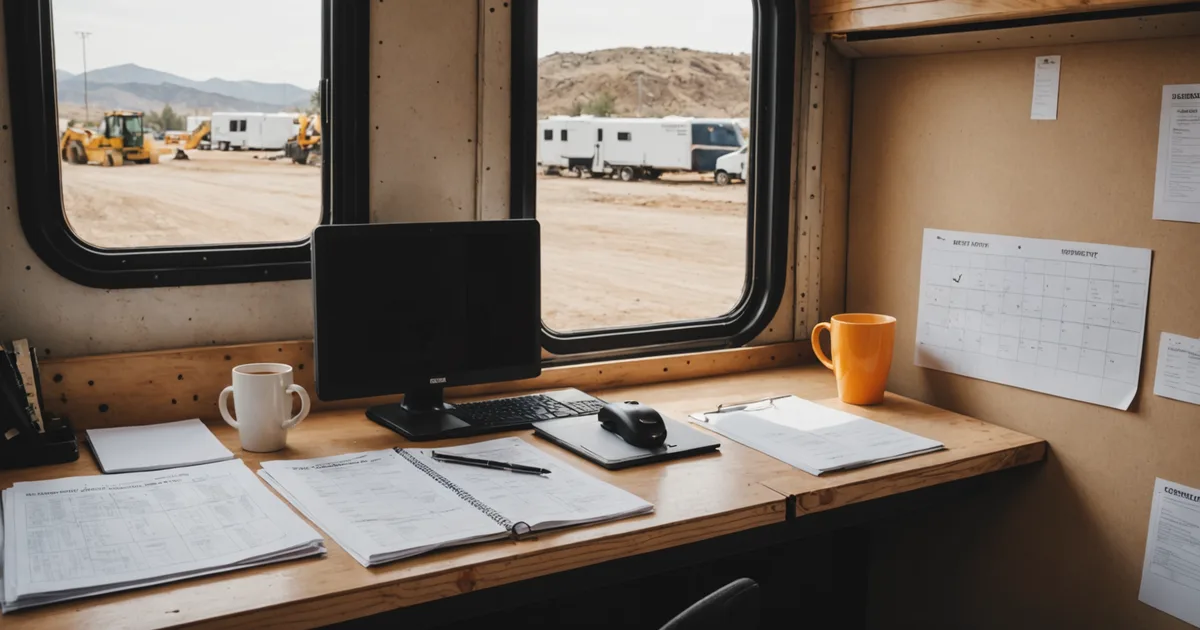
On any active commercial construction project, a superintendent writes a daily log. The content varies in quality and detail, but a good superintendent's log is genuinely remarkable: crew counts by trade, weather observations, material deliveries, equipment problems, safety incidents, coordination issues, verbal instructions from the PM, and short notes about work that was planned and didn't happen. A week of daily logs from an experienced field leader is arguably the richest real-time data source on the entire project.
Almost none of it gets synthesized.
The PM reads the log. Sometimes. They may catch the note about the concrete crew being short two people on Tuesday. They may not connect it to the look-ahead schedule showing framing is supposed to complete by Friday. They almost certainly don't connect it to the RFI from two weeks ago about reinforcing placement that's still technically open, because those are in different systems, reviewed on different rhythms.
Why Daily Logs Are Underused
The challenge isn't that daily logs are bad data. It's that they're unstructured narrative data in a project environment that runs on structured schedule data. Gantt charts, baseline schedules, CPM models: these are formats that software can read, filter, and report on automatically. Daily logs are paragraphs. Software doesn't know what to do with paragraphs.
So daily logs end up serving primarily as documentation: proof of conditions on a given day, useful for resolving disputes, occasionally useful for investigating a delay after the fact. The prospective use (reading today's log to catch a risk that will compound over the next two weeks) almost never happens systematically.
On a busy project, a PM managing five to eight subcontractor scopes in parallel doesn't have the time to read five daily logs in depth, cross-reference each observation against the look-ahead, and synthesize what it means for schedule risk by 8 AM. So they skim. They catch the obvious things. The subtle accumulation patterns (three consecutive days of weather notes that nobody's counting, crew shortfalls that each individually seem minor) go unread until the 30-day update makes them obvious.
What Logs Actually Contain
Consider the kinds of observations that appear in daily logs on a typical commercial project week:
Monday: concrete crew mobilized 4 persons, planned 6; held off south wall pour pending electrical stub-out verification. Tuesday: rain delay 0.5 hours morning, concrete crew still 4 persons, completed interior column pour block D. Wednesday: concrete crew 5 persons, completed block D east wall, weather clear. Thursday: electrical sub short 1 foreman, concrete crew back to 6, east wing framing 60% complete per plan. Friday: all crews full count, east wing framing punch list items pending re-inspection.
A single week of daily logs like this contains four meaningful signals. The crew shortage on Monday and Tuesday was a two-day delay signal in a float-limited activity. The electrical sub short a foreman on Thursday may be a leading indicator of a pattern or a one-off. The "pending re-inspection" note on Friday is the first mention of a quality issue that will need to be tracked. The weather delay was documented but needs to be cross-referenced against the contract's adverse weather clause to know if it's a compensable delay or within the baseline allowance.
None of these signals are individually alarming. Together, in the context of the CPM schedule and the RFI register, several of them are worth a phone call this week rather than a change order next month.
The Superintendent's Perspective
It's worth noting that the person writing the log is often not the same person who most needs its insights. The superintendent documents conditions. The PM synthesizes conditions into schedule risk. The project executive communicates risk to the owner. This chain of custody introduces latency at every step.
The superintendent writes the log at the end of the day, usually in Procore or a Fieldwire daily log field. The PM reviews it the next morning, or maybe at end of week during report preparation. The project executive sees the synthesized version in the weekly status meeting. By the time the electrical sub's consistent foreman shortage reaches the project executive as a schedule risk, five days have passed and the window to act efficiently may have closed.
General contractors who've worked hard on this problem have tried various approaches: requiring more structured log formats, daily log summary meetings, weekly flag reviews. These help at the margins but don't solve the fundamental problem: synthesis at project scale requires reading across too many parallel threads for any one person to do consistently.
The Automation Opportunity
What automation can do here isn't replace the superintendent's log. The log stays as it is, written by people who understand the field, in whatever form they're comfortable with. What changes is what happens to it after submission.
A system that reads each day's logs, extracts crew counts and weather observations and material shortage notes, and cross-references them against the active schedule can return a short summary to the PM by 7 AM: "Concrete crew has been at or below planned count 3 of the last 4 days. Block D framing has 2 days of float remaining. RFI #52 on mechanical penetration clearances has been open 9 days and is on the look-ahead for the week of the 23rd."
That paragraph takes about 30 minutes to synthesize manually. It takes 30 seconds to read and act on. The PM doesn't need to read five daily logs. They need to read one synthesis that's already connected the signals that matter.
What This Doesn't Replace
Field judgment isn't automated by reading logs. The superintendent who knows that the concrete crew foreman called in sick, not that the crew is genuinely understaffed, is making a judgment call that matters for interpretation. The PM who knows that a particular subcontractor always writes conservative notes and almost never actually falls behind is reading the logs with contextual knowledge that's hard to encode.
The automation opportunity is in the synthesis layer, not the judgment layer. Get the signals assembled and prioritized. Let the people with field experience decide which ones require action and which ones are noise. That division of labor is more honest about what software is actually good at in a construction context, and it's where the most reliable value lives.
Daily logs have always been the best data source in construction. The only thing missing is a reason to read them the same day they're written.